Pharmaceutical Analysis Group
Welcome to Pharmaceutical Analysis!
It may surprise you to hear that the research group, Pharmaceutical Analysis, isn’t just about analysis anymore. Our research scope has expanded well beyond instrumental analysis to focus on advanced, technology-driven medical and pharmaceutical science. We work not only with microfluidics (Sabeth Verpoorte), but also nanomedicines (Christoffer Åberg) and 3D cell-culture-based systems for studying toxicology and disease (Anika Nagelkerke). Daan Touw, hospital pharmacist and clinical toxicologist, completes our scientific research team with ample experience in the applications where our technologies could make a difference for medical researchers and patients alike. Here’s a short introduction to our research group.
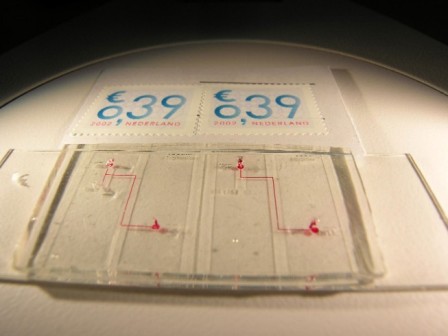
Besides heading the research group, Sabeth Verpoorte uses microfluidics (lab-on-a-chip) to address research questions in the pharmaceutical sciences. Microfluidic devices consist of hair-fine interconnected microchannels, in which minute samples can be processed in an exquisitely controlled manner. Continuous-flow particle separation strategies in nanoliter volumes are being developed, as well as miniaturized analytical instrumentation. Cells and tissue can also be cultured in these devices, in engineered microenvironments that emulate in vivo niches so that resulting cellular response more accurately reflects in vivo cell response. So-called organ-on-a-chip systems to study drug metabolism (liver chip, gut chip), organ interactions (e.g. intestine-liver chip), and disease (liver cholestasis, diabetic kidney disease) are being realized based on microfluidics.
Christoffer Åberg’s research focus involves the internalisation into and subsequent distribution of nano-sized objects in human cells, for applications in drug delivery using nano-sized vehicles (nanomedicine) or to avoid adverse effects stemming from nanotechnology (nanosafety). In particular, we are interested in how the absorption and distribution depend upon properties of the objects (e.g., size) and the cells. Experimentally, we use techniques such as live-cell imaging and flow cytometry to gain quantitative data; on the theoretical side we model the processes using simple pharmacokinetic models and/or as stochastic processes.
Vesna Bacheva’s research focuses on engineering cellular microenvironments to probe living systems, advancing both fundamental understanding and translational applications. We develop lab-on-a-chip platforms that integrate microfluidics, biosensing, and biophysical modeling to dissect how cells respond to dynamic mechanical and biochemical environments. Using these platforms, we investigate how mechanical forces and transport processes shape cellular behavior across biological systems. Our goal is to uncover the fundamental principles by which cells sense, encode, and respond to mechanical cues. Beyond discovery, we aim to translate these insights into new technologies, laying the foundation for next-generation organ-on-chip systems that faithfully mimic tissue mechanics for applications in personalized diagnostics and drug testing.
Anika Nagelkerke works on cancer - not just on the cancer cells themselves, but also on the fascinating surroundings in which these cells grow. This so-called tumour microenvironment might be more important for drug efficacy than you may think. In the laboratory, we are building advanced models for cancer, working at the crossroads of biology and technology. We are using cell cultures, extracellular matrix, biomaterials, on-chip technology and microfluidics. With the developed systems, we want to recreate the heterogeneous tumour microenvironment and establish how it influences drug efficacy. We aim to uncover drug resistance mechanisms and establish biomarkers and novel therapeutic targets.
Daan Touw is the former head of the laboratory of the Department of Clinical Pharmacy and Pharmacology in the UMCG and emeritus professor of Bioanalysis, Therapeutic Drug Monitoring and Clinical Toxicology. His research aimed at developing new assays to be used in clinical practice and also to develop these assays in other matrices besides ‘normal’ blood samples, such as tissue, dried blood spots (DBS), saliva and hair. His other research themes were drug pharmacokinetics and the genetic variants influencing drug pharmacokinetics. Currently his research is focused on the development and implementation of MALDI methods to quantify drug distribution in tissues and the difference in pharmacokinetics in females compared to males, and the effect of aging on these differences (puberty, menopause).
In short, we have a unique group whose activities span physics, physical chemistry, analytical chemistry and microfluidics through to bioanalysis, clinical toxicology and cell biology. We feel that this is a great recipe for dynamic interdisciplinary research which will yield significant advances in the medical and life sciences. If you are interested in innovative techniques, a multidisciplinary work environment and an enjoyable work atmosphere, then Pharmaceutical Analysis could be just the place for you!